TWO:In the early portion of the reign the manners and customs differed little from those described in the preceding one. There was great dissipation, and even coarseness of manners, amongst the nobility and gentry. It was the custom to drink to intoxication at dinners, and swearing still garnished the language of the wealthy as well as of the low. Balls, routs, the opera, the theatre, with Vauxhall and Ranelagh, filled up the time of the fashionable, and gaming was carried to an extraordinary extent. Amongst our leading statesmen Charles Fox was famous for this habit. Duelling was equally common, and infidelity amongst fashionable people was of[203] notorious prevalence. George III. and his queen did what they could to discourage this looseness of morals, and to set a different example; but the decorum of the Court was long in passing into the wealthy classes around it. An affluent middle class was fast mingling with the old nobility, and this brought some degree of sobriety and public decency with it. Amongst the lower classes dog-, cock-, and bull-fights were, during a great part of the reign, the chief amusements, and the rudest manners continued to prevail, because there was next to no education. Wesley, Whitefield, and their followers, were the first to break into this condition of heathenism. Robberies and murders abounded both in town and country, and the police was of a very defective character. For the most part there was none but the parish constable. The novels of Fielding and Smollett are pictures of the rudeness and profligacy of these times. The resources in the country of books and newspapers were few, and the pot-house supplied the necessary excitement. The clergy were of a very low tone, or were non-resident, and the farmers, getting rich, aped the gentlemen, followed the hounds, and ended the day with a carouse.
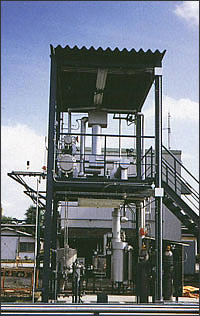
Great attention is recently being paid to global environmental issues, and it is now conceivable that companies will need to treat used solvents themselves. In consideration of this kind of social issue, we have developed a “membrane separation type solvent dehydration system,” which uses a polyimide membrane with superior dehydration properties developed by Ube Industries, Ltd. in combination with our own distillation and concentration technology that has resulted in solvents being more easily recovered.
THREE:
- 1Under the distillation system, even in case of azeotropic solvent compositions, this system which remove water vapor by the polyimide membrane will easily dehydrate.
- 2In comparison with the distillation system, it significantly saves on use of steam.
- 3Dehydration can be performed through merely supplying evaporated vapor to the membrane module and maintaining the differential pressure between the permeable side and the impermeable side.
- 4Solvent purity of 99.9% or more can be achieved by carrying out dehydration with a polyimide membrane only.
- 5The polyimide membrane has superior heat and solvent resistance. Therefore, the vapor permeation system reduces contamination of the membrane and thus extends its life.
THREE:The French had always beheld with jealousy our possession of the island of Minorca, which had been won by General Stanhope in 1708, and secured to us by the Peace of Utrecht. That England should possess the finest port in the Mediterranean, and that so near their own shores, was a subject of unceasing chagrin. The miserable administration of British affairs, the constant attention to the interests of Hanover instead of our own, now inspired France with the resolve to snatch the prize from us. Great preparations were made for this object, and the report of these as duly conveyed to the English Ministers by the consuls in both Spain and Italy, but in vain. At length the certainty that the French were about to sail for Minorca burst on the miserable Ministers; but it was too late¡ªthey had nothing in readiness. The port of Mahon was almost destitute of a garrison; the governor, Lord Tyrawley, was in England; and the deputy-governor, General Blakeney, though brave, as he had shown himself at the siege of Stirling, was old, nearly disabled by his infirmities, and deficient in troops. What was still worse, all the colonels were absent from the regiments stationed there, and other officers also¡ªaltogether thirty-five!
The aromatic polyimide membrane is highly permeable to water vapor but less permeable to vapors of organic compounds such as alcohol etc.
THREE:The Emperor Joseph of Austria had returned from the campaign of 1788 against Turkey greatly chagrined, and with fast-failing health. Had he been wise, he would have accepted the overtures for peace made to him by the Sultan, and have spent the few remaining days of his existence in tranquillity. But his ambitious and persuasive ally, Catherine, prevailed upon him to make another effort. He mustered fresh troops. A hundred and fifty thousand men were marched against the Turkish frontier, early in the year of 1789, in different divisions. It was a circumstance very much in their favour that the able Sultan, Abdul Hamid, died suddenly in April, and was succeeded by his nephew, Selim, a young, rash, and unprincipled man. The acts of Selim, in murdering and dismissing his father's best ministers and commanders, and the unruly condition of the janissaries, rendered Turkey especially open to the attacks of its enemies. Marshal Laudohn, supporting his earlier fame, took the fortress of Gradiska, and stormed Belgrade. But this was not accomplished till the 8th of October, and an attempt was then made to reduce Orsova, but this failed. Coburg and Suvaroff having joined, won a great victory over the new Vizier, Martinitzi, in Wallachia, on the 22nd of September, and the remains of the Turkish army retired to the pass of Shumla, on the Balkan mountains. Potemkin, on his part, had greatly increased his forces after the reduction of Oczakoff, and after a desperate resistance took Bender, famous as the abode of Charles XII. of Sweden, after the battle of Pultawa. Before winter, the Russians had made decided progress in their inroads into the Turkish dominions on the Black Sea. They had gained possession of Akerman, at the mouth of the Dniester; of Keglia Nova, on the northern banks of the Danube, and of other places on the Black Sea. They had also extended their frontier to the left bank of the Danube, and they had actually reduced every important place between the Bug and Dniester and that river. Had Catherine had a sufficient fleet in the Black Sea, Constantinople might have trembled for its safety.
- 1 Recovery of the detergent solvent Recovery of the cleaning solvent such as electronic parts industry, precision instrument industry.
- 2Solvent recovery and the refinement Solvent recovery and the refinement such as chemical industry, an industry of medical supplies, food industry, the fermentation industry.
THREE:
Acetone, ethanol, methyl ethyl ketone, butanol, isopropyl alcohol, ethyl acetate, methyl isobutyl ketone, others (including hexane and toluene).
